

In my day-to-day work, I often talk with business owners who don’t understand why their campaigns generate conversions without those results actually turning into business growth.
On paper, the numbers look good: cost per conversion is solid, volume is climbing, and the platforms say the goals are being met. But behind those numbers, forms don’t always turn into qualified leads, some calls turn out to be support requests, and cart additions don’t necessarily lead to sales.
This gap doesn’t necessarily mean the campaigns aren’t working. Mostly, it shows that not all conversions carry the same weight, and they don’t always tell you what’s truly driving results.
So measuring a conversion isn’t enough. You need to know where it sits in the customer journey, what it’s really worth to the business, and whether it should shape how you optimize your campaigns. In other words, how do you know if the platforms are producing real business results, or just signals that look like performance without actually helping you make better decisions?
From click to sale: the journey is rarely that simple
The customer journey is sometimes described as the path from an ad click to first contact. In reality, it usually starts well before that click and continues long after the sale. For a lead-generation business, the journey might look like this:
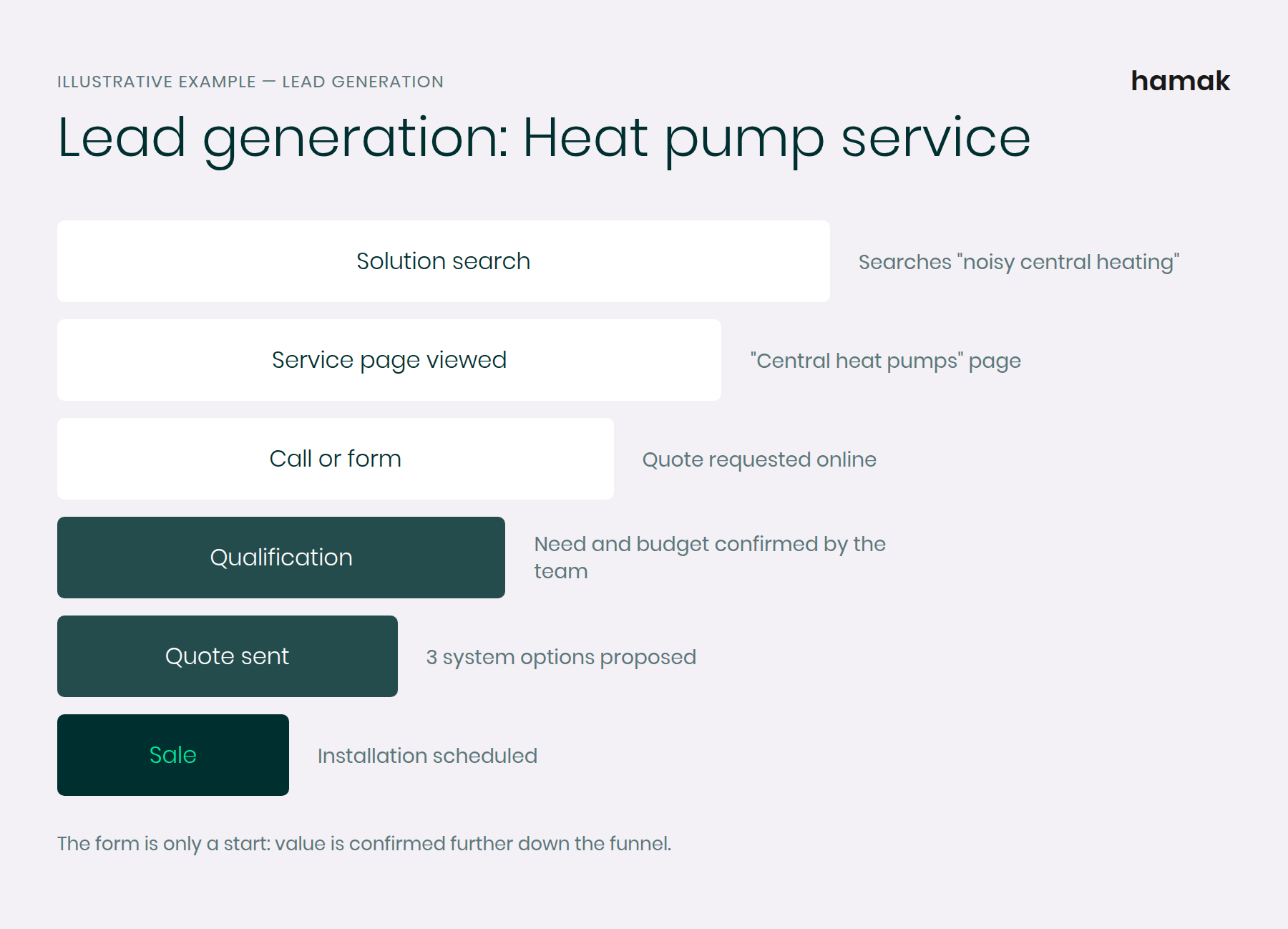
For e-commerce, it might follow a different sequence:
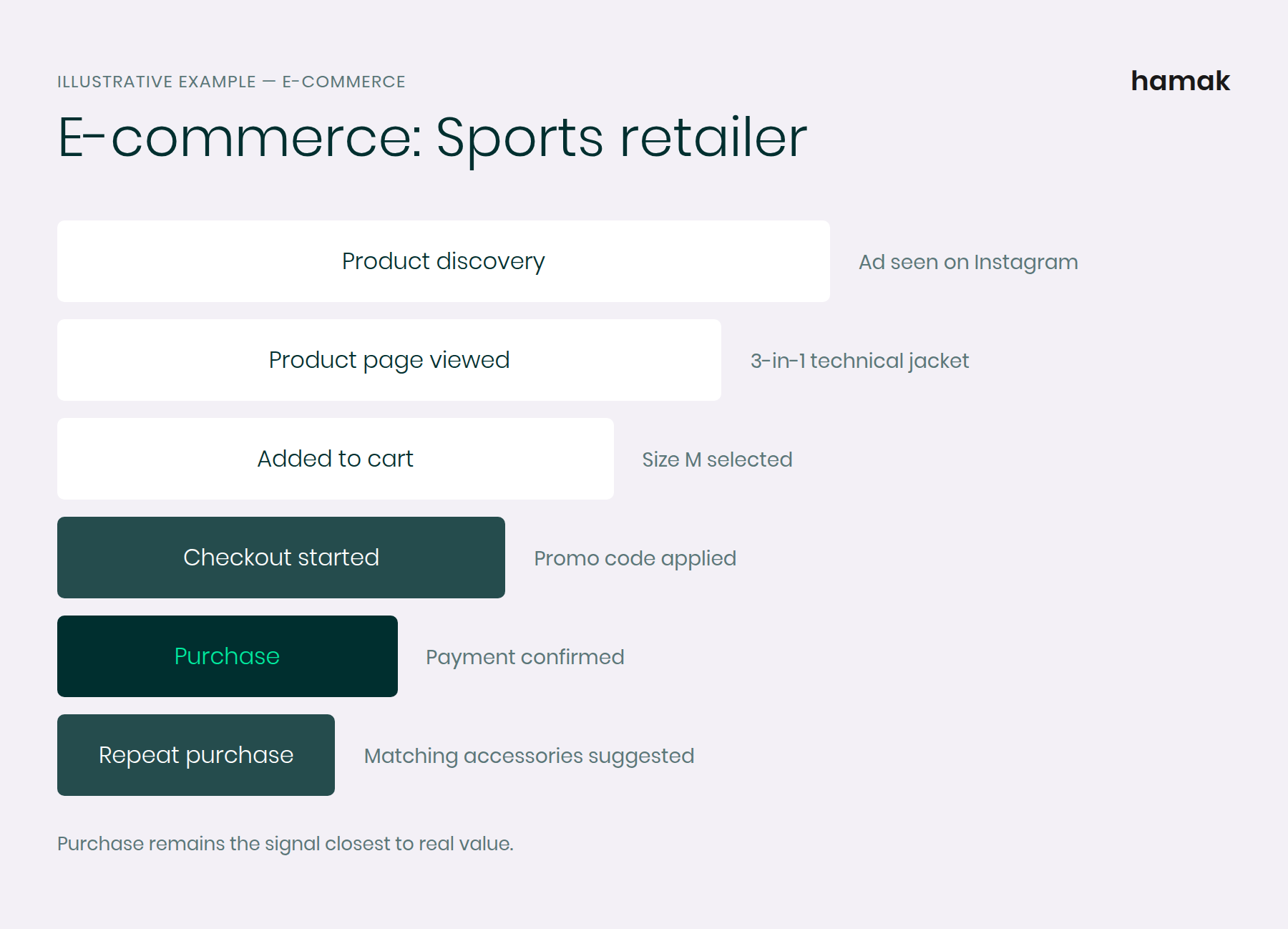
Of course, real journeys are rarely this straightforward. Someone might browse several pages, come back a few days later, call, visit a store, and then buy. Someone else might fill out a form on their very first visit.
The goal of mapping this out isn’t to claim every customer follows the same path. It’s to spot the steps that show real movement toward a business outcome.
Measuring, sure, but measuring what?
Once you’ve identified the main steps in the customer journey, you need to figure out which ones to measure and how to read them.
A button click might show interest. A form might turn into a qualified lead… or a request that goes nowhere. A call might be about a quote, or it might just be a support question. Without context, these actions only give you a partial picture of performance.
So the first question isn’t just “what can we measure?” It’s “which actions actually matter to the business?”
This is something to work through with the client. The media team can set up tracking and spot trends, but the business itself is best placed to say what separates a promising lead from a profitable sale or a meaningful step in its sales process.
At Hamak, we work to connect ad data with what’s actually happening on the ground. How many forms turned into qualified leads? Which calls led to a quote? Which campaigns generated sales rather than just first contact?
That connection is what turns campaign data into something you can actually use to make decisions.
Not every conversion deserves equal weight
In Google Ads, conversion actions can be set up as primary or secondary. This isn’t just about organizing reports. It also partly determines which signals guide the bidding.
A primary conversion can directly shape campaign optimization. A secondary conversion stays visible for analysis but doesn’t necessarily need to influence the algorithm’s decisions.
This choice matters. If an easy-to-generate action gets treated as the top priority, the platform will naturally produce more of it, even if it does little for the business’s real goals.
Take an e-commerce example. It can be useful to track:
- product page views
- cart additions
- checkout starts
- purchases
These events help you understand where users move forward, hesitate, or drop off. But they don’t all carry the same weight.
A purchase is generally the signal closest to real business value. The earlier steps are more useful for studying behavior, spotting friction points, or supporting optimization when sales volume is still too low.
The same logic applies to lead generation. A click on a phone number shows intent, but doesn’t confirm a call actually happened. A submitted form shows first contact, but not necessarily a qualified lead. And even a qualified lead isn’t worth the same as a closed sale yet.
So the goal isn’t to track fewer actions. It’s to give each one the right role. Some conversions should guide bidding, while others mainly help build a fuller picture of what happens before the final outcome.
The real question: lead quality
This distinction matters a lot in lead generation. It’s not just about service businesses. It also applies to products that require more thought or a sales team’s involvement, things like industrial equipment, tractors, heating systems, or tech solutions.
In these cases, the conversion tracked on the site is often just the start. After a form submission, a call, or a booked appointment, the lead still needs to be contacted, qualified, and guided along before it turns into a quote or a sale.
But the ad platform doesn’t always see what happens after that first contact. If tracking stops at the form or the call, it may treat every request as equally valuable, even when some don’t match the profile you’re looking for.
A call isn’t automatically a lead
You can track how many calls come from an ad or a website, and how long they last, but that data alone doesn’t tell you much about quality. A call lasting several minutes could lead to a quote, or it could just be about a bill, a product problem, store hours, or a job application. Call length is a clue, not an answer.
To know which campaigns bring in the strongest requests, you need to look further down the funnel. A CRM, a sales team, or a qualification system can confirm whether a call or form turned into a qualified lead, a quote, or a sale.
At Hamak, our check-ins with clients exist to connect the conversions we see on the platforms with the outcomes the sales teams actually observe. That’s how you can tell campaigns that bring in a lot of requests apart from ones that actually attract the right leads.
The goal isn’t just to increase the number of forms or calls. It’s to understand which campaigns actually drive business growth, and to use that information to optimize them better.
Offline conversions for a clearer read on performance
In lead generation, offline conversions let you show Google Ads what happens after the form or the call. When someone clicks an ad, Google can assign them a unique identifier called a Google Click Identifier (GCLID). This identifier can be stored in the CRM along with the lead’s information. If that request later turns into a qualified lead, a quote, or a sale, this outcome can be imported back into Google Ads and linked to the original click.
Enhanced conversions for leads take this further. They also use protected first-party data, like a hashed email address or phone number, to better match leads collected online with outcomes recorded in the CRM. Google actually recommends this approach over the standard GCLID-only import.
The goal isn’t just richer reports. It’s to give the platform signals closer to real value: not just that a form was filled out, but that it led to a qualified lead or a sale. That way, Google Ads can better identify the campaigns, searches, and audiences that actually drive business results.
A concrete example
Take two campaigns promoting heating systems.
Each generates 20 forms at a cost of $50 per conversion. In Google Ads, the results look identical.
Once the leads are qualified, the picture changes: the first campaign leads to two sales, while the second generates eight.
In e-commerce, the purchase remains the strongest signal
For an e-commerce platform, a completed purchase is generally the action that best reflects the value a campaign generates.
The earlier steps are still useful, though. A product view, a cart addition, or a checkout start can help you spot where the journey slows down, a product page that draws interest but doesn’t convince, a cart that creates friction, or shipping costs discovered too late, for example.
These actions can also support optimization when there aren’t yet enough purchases to properly feed the algorithms. This isn’t just a launch tactic. A store that makes few sales each month may need to lean on a step like cart additions for longer.
The choice comes down to two things: how much data is available and how close the action is to the actual sale.
The earlier a conversion happens in the journey, the more often it occurs, but the less clearly it signals real purchase intent. The goal is to pick the furthest-along action that still generates enough data to support optimization.
You also need to be careful when assigning value to these in-between actions. That value should be based on observed data, for example, the share of cart additions that actually lead to a purchase. If you arbitrarily assign a cart addition the same value as a sale, you risk distorting how you read performance.
Do store visits count as conversions?
For businesses that also have physical locations, campaign results aren’t always limited to online purchases.
For certain eligible accounts, Google Ads can estimate store visits that happen after someone interacts with an ad. This data helps you better understand how campaigns contribute across an omnichannel journey, even though a visit doesn’t automatically mean a sale.
When the data allows for it, it can also be worth connecting in-store sales to digital ad spend. The goal stays the same: measure the outcome as far down the journey as possible, rather than stopping at the last visible action on the site.
When a good indicator becomes a bad conversion
A brand-awareness campaign shouldn’t be judged the same way as a sales campaign. For a display or video campaign, impressions, reach, frequency, visibility, or site interactions can help you gauge how well it’s reaching and resonating with an audience.
An engaged session in Google Analytics 4 can also work as a secondary indicator for comparing traffic quality, landing pages, or placements. But it doesn’t prove that someone has become a customer, or is seriously considering it.
The problem starts when this kind of signal gets treated as a business conversion.
A button click, a page visit, an unqualified call, or a cart addition can all add useful context. But if they directly guide optimization, Google Ads will end up chasing whichever actions are easiest to generate, rather than the ones that actually drive sales or leads.
This is sometimes called vanity conversions: they make the numbers in your reports look better without necessarily reflecting real progress toward your business goal.
Tracking more events doesn’t always give you a clearer picture. A simpler setup, with a handful of well-defined conversions that match the goal of each campaign, usually leads to better decisions.
The right conversion is the one that helps you decide
Measuring well isn’t about tracking as many actions as possible. It’s about telling apart the indicators that are useful for analysis from the outcomes that should actually guide your campaigns.
A platform can only optimize based on the signals it receives. The closer those signals are to a qualified lead, a sale, or another outcome that matters to the business, the more optimization can reflect what’s actually happening in the business.
Getting there often means going beyond the tracking already set up on your site: mapping the customer journey, ranking conversions by what matters, connecting ad data with CRM data, and regularly revisiting the goals behind each campaign.
The most common conversion isn’t always the most useful one. The right conversion is the one that helps you understand what actually creates value, and helps you make better decisions. To go further and find the best ways to improve things for your situation, get in touch with our team of experts.