

On August 17, Google will change the way its bidding strategies use CPA and ROAS targets. At first glance, the update may seem like a minor technical adjustment. In practice, however, it could lead to a significant decline in performance for some advertisers.
Its impact will vary from one campaign to another and may easily go unnoticed. How can you determine whether your campaigns will be affected and, more importantly, adjust them before performance begins to suffer?
What’s changing and why should you prepare?
To understand the potential impact of this update, it helps to first review how target-based bidding strategies, such as Target CPA and Target ROAS, currently work.
When a target is particularly ambitious relative to the available budget, the algorithm tends to moderate its bids rather than spend the entire budget as quickly as possible. It prioritizes the opportunities most likely to generate a strong return and distributes spend more evenly throughout the day.
In many Google Ads accounts, some campaigns currently operate under a specific set of conditions: they use a target CPA or ROAS, they are limited by their daily budget, and they still achieve results that significantly outperform the target.
In other words, Google “picks its battles.” The target effectively becomes secondary, while the algorithm focuses on maximizing conversions—or conversion value—within the available budget.
This is why these campaigns have historically been able to outperform their targets. However, this behaviour also had a downside. When the daily budget was increased, return on investment could decline much faster than expected because the campaign suddenly had to compete for less profitable opportunities. As a result, scaling could become unpredictable.
Starting August 17, Google will adhere more closely to the target entered in the platform. If that target is too aggressive relative to the available budget, the campaign may bid more aggressively, exhaust its budget earlier in the day, and move closer to the target CPA or ROAS—even if doing so results in weaker performance than it currently achieves.
A concrete example
Consider a campaign with a daily budget of $200 and a target ROAS of 5.
Let’s assume the campaign is heavily constrained by its budget and that, based on available demand, it could spend up to $1,000 per day while maintaining a ROAS of 5.
Under the current system, the bidding strategy may prioritize maximizing the return generated by the available budget rather than strictly aiming for a ROAS of 5. By focusing only on the most profitable opportunities, the campaign could generate an actual ROAS of 10 on its $200 daily spend.
After the update, the strategy will instead aim to stay more closely aligned with the target ROAS of 5. Since the daily budget is not sufficient to capture all available opportunities at that target, the campaign could spend its entire $200 early in the day, achieve a ROAS closer to 5, and then stop serving ads.
In this simplified example, the campaign’s actual ROAS could therefore decline from 10 to 5—a 50% decrease.
| Aspect | Before August 17: current behaviour | After August 17: new behaviour |
| Algorithm behaviour | Operates more like Maximize Conversions or Maximize Conversion Value | Adheres more closely to the CPA or ROAS target |
| Delivery pacing | Spend is distributed throughout the day | The budget may be exhausted earlier in the day |
| Performance | May significantly outperform the target, such as a ROAS of 10 instead of 5 | Performance may move closer to the target, such as a ROAS of 5 |
| Scaling after a budget increase | Performance may fluctuate or decline unpredictably | Scaling and returns should become more predictable |
Google is presenting this update as a way to give advertisers greater predictability. It should help campaigns remain more closely aligned with their configured targets, but in some cases, that predictability may come at the expense of performance.
The update could also increase competition in auctions and encourage some advertisers to raise their budgets to maintain their existing volume and visibility throughout the day.
Our approach: proactive campaign control
At Hamak, we avoid operating campaigns under significant budget constraints whenever possible.
We prioritize daily budgets that give bidding strategies enough flexibility to learn, evaluate available opportunities, and generate the strongest possible results.
We then manage the rate of spend primarily through the bidding target. To increase spend and generate more volume, we loosen the target by raising the target CPA or lowering the target ROAS. Conversely, to reduce spend or better protect profitability, we tighten the target by lowering the target CPA or raising the target ROAS.
This approach provides more precise control over campaign delivery and helps maintain performance when external conditions—such as search volume or competitive pressure—change.
How can you prepare your campaigns?
If some of your campaigns use a target CPA or Target ROAS strategy and are also constrained by their daily budget, manual adjustments may be required before mid-August.
The main objective is to align the performance target and the daily budget so that both reflect the same level of ambition.
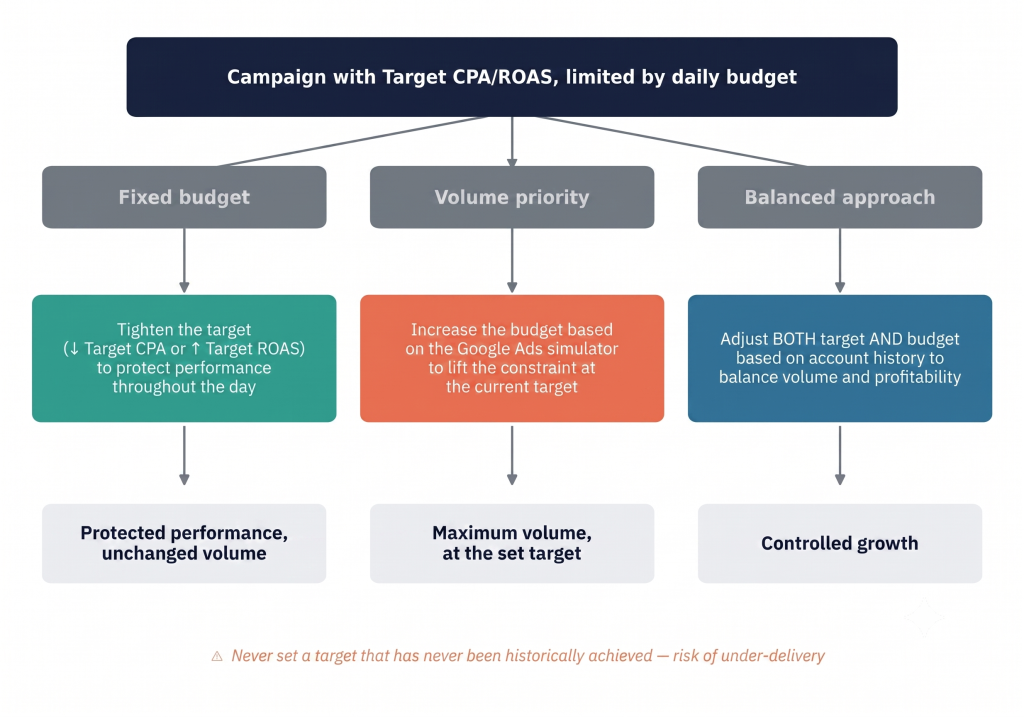
Depending on your organization’s priorities, there are three main approaches.
1. Your budget is fixed
If your overall budget cannot be increased, your priority should be to maintain strong performance throughout the day.
In this situation, consider lowering the target CPA or raising the target ROAS so that the campaign remains selective enough to avoid exhausting its budget too early.
Expert tip: Use recent campaign results—such as performance over the last 30 days—to establish a realistic new target.
2. Your priority is volume
If your primary objective is to generate as many sales or leads as possible, and the target entered in the platform represents your organization’s true break-even point, the budget should no longer be allowed to constrain delivery.
To maximize volume at the established target, we recommend increasing the daily budget to the amount suggested by the Google Ads budget simulator. By setting a budget that no longer limits delivery, the campaign should be able to scale more predictably while maintaining the intended return.
3. You’re looking for balance
You do not necessarily have to choose between these two approaches.
A hybrid strategy involves adjusting both the target and the daily budget based on the desired balance between volume and return.
This approach requires a deeper understanding of the account, its performance history, and the specific dynamics of the industry. When properly calibrated, however, it can support growth while maintaining an acceptable level of profitability.
Regardless of the approach you choose, avoid tightening the target too aggressively.
Setting a CPA or ROAS target that the campaign has never historically achieved could significantly reduce its ability to participate in auctions—or even cause delivery to stop almost entirely.
What could this mean for the industry?
This update could indirectly affect auction dynamics in certain industries.
Auction pressure may increase earlier in the day if major advertisers fail to make the necessary adjustments before the deadline and begin spending their budgets more aggressively in the morning.
However, this effect is likely to remain limited—or may not occur at all—in most industries. A broader increase in competition is still possible if a large number of advertisers decide to raise their budgets to maintain their current volume.
The key takeaway
Google’s upcoming update could significantly affect campaigns whose targets are not properly aligned with their available budgets.
Advertisers should immediately identify campaigns that are limited by budget, review their recent performance, and determine whether the target, the daily budget, or both should be adjusted.
The objective is not necessarily to spend more. It is to ensure that the settings provided to Google Ads accurately reflect the organization’s desired level of spend and return.
Auditing your bidding strategies before August 17 can help prevent unpleasant surprises. If a campaign is budget-constrained but significantly outperforms its target CPA or ROAS, it is likely a sign that an adjustment is required.
Not sure how this change could affect your campaigns? Our media team can assess your situation and recommend the adjustments needed to protect your performance.